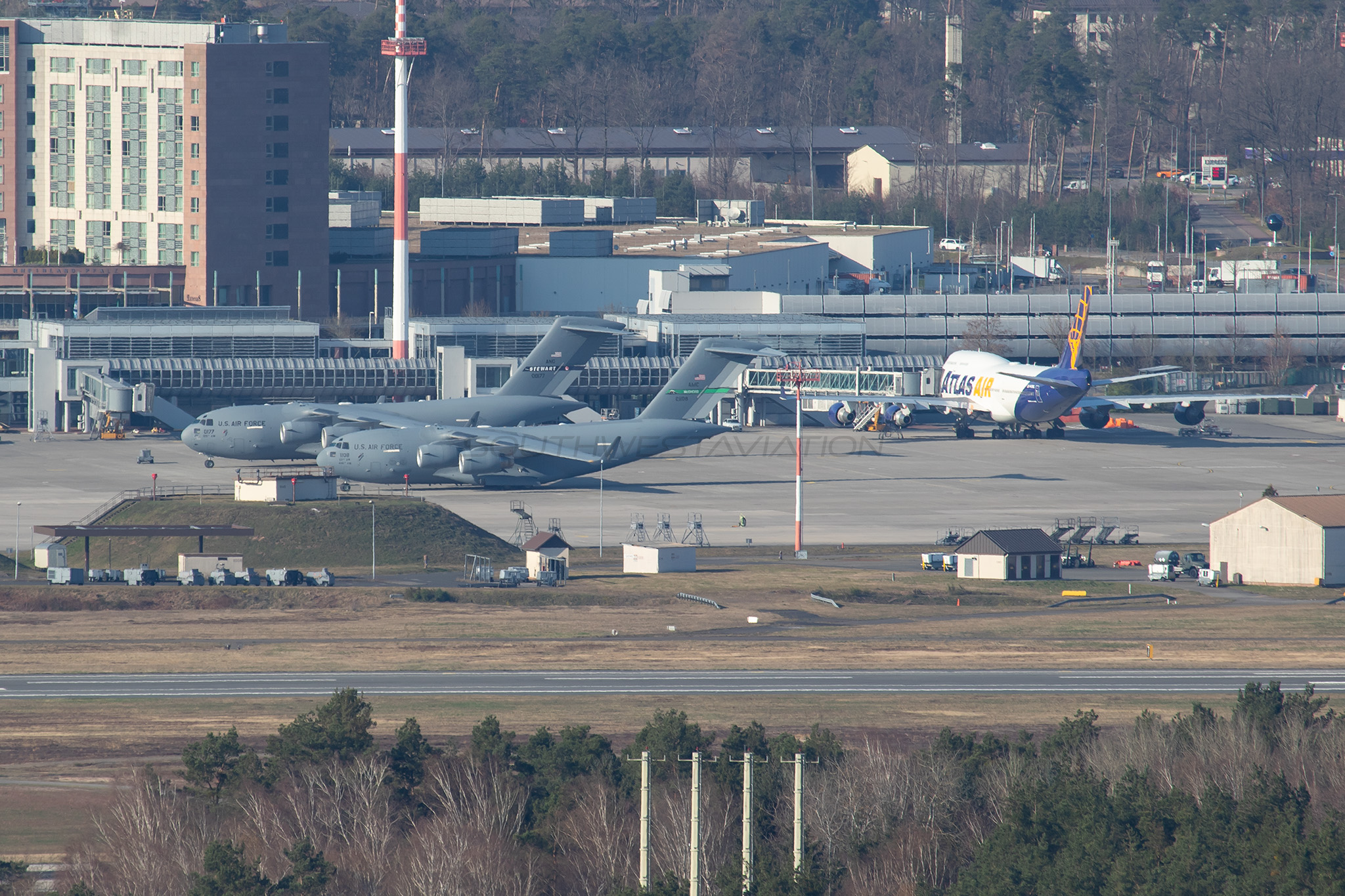
Short Description
Ramstein Air Base is located in southwest Germany in the state of Rhineland-Palatinate, a few kilometers west of the city of Kaiserslautern. The surrounding region is predominantly rural, characterized by extensive forests, agricultural land, and small villages, while still offering efficient infrastructure and access to nearby urban centers.
This combination of a low population density and strong transportation links provides ideal conditions for the largest U.S. Air Force base outside the United States. Ramstein Air Base is an integral part of the Kaiserslautern Military Community, which represents the largest American military community outside the U.S. mainland and includes numerous support facilities and installations in the region.

The base benefits from its central location within Europe, enabling rapid airlift operations and efficient logistical support across the continent. At the same time, its geographic position allows for flight routes to regions of strategic importance, including Eastern Europe, Africa, and the Middle East.
In addition, Ramstein Air Base maintains frequent and direct transatlantic connections to the United States, further reinforcing its role as a primary hub for personnel movement, medical evacuation, and global mobility operations within the U.S. Air Force and NATO framework.
Historical Summary
Ramstein Air Base was established in the early 1950s during the Cold War, reflecting the growing strategic importance of West Germany for NATO and the United States. Built on the sites of the former German airfields of Ramstein and Landstuhl, construction began in 1951, and the base became operational in 1953 as a logistics and support hub for U.S. Air Forces in Europe.
Throughout the Cold War, Ramstein developed into a key element of NATO’s defense strategy and played an important role in deterring the Warsaw Pact. The base supported airlift operations, logistical coordination, and served as a major transit point for personnel and equipment between the United States, Europe, and other regions.
After the Cold War, Ramstein adapted to new security challenges and shifted its focus toward crisis response and international missions. The base supported operations in the Balkans and later became a central hub for missions in the Middle East, including Afghanistan and Iraq.
Today, Ramstein Air Base remains the largest U.S. Air Force installation outside the United States and hosts the headquarters of U.S. Air Forces in Europe – Air Forces Africa (USAFE-AFAFRICA). Its history reflects the long-standing military cooperation between the United States, Germany, and NATO allies.
Runway information
Ramstein Air Base has two asphalt runways:
- Runway 08/26 — approx. 3,191 m (10,468 ft) long and 45 m wide.
- Runway 09/27 — approx. 2,990 m (9,811 ft) long and 45 m wide.
Primary runway:
Runway 08/26 is used most of the time for both departures and arrivals. This runway is the main operational runway for airlift flights and most scheduled movements due to its length and alignment with prevailing winds.
Secondary runway:
Runway 09/27 sees much less use and is often reserved for taxiing, occasional arrivals, or specific operations when needed. It provides redundancy but is not the primary runway under normal conditions.
Based units
86th Airlift Wing (86th AW)
- The host wing of Ramstein Air Base, responsible for airlift operations, aeromedical evacuation, and support missions
86th Operations Group
- Conducts tactical airlift, airdrop missions, and passenger transport.
521st Air Mobility Operations Wing (521st AMOW)
- Coordinates and manages strategic air mobility operations across Europe, Africa, and Southwest Asia.
406th Air Expeditionary Wing
- An expeditionary unit supporting operations primarily focused on Africa.
NATO Allied Air Command (AIRCOM)
- NATO’s headquarters responsible for planning and executing air and missile defense operations in Europe.
Based aircraft
Ramstein lost its fighter operations (86th Tactical Fighter Wing) in 1994 when the F-16s were relocated to Aviano in Italy. Since then, only a few VIP and transport aircraft of the 86th AW have been based there:


Movements
The most common aircraft movements are military cargo aircraft, such as C-17s and C-5s. ETAR is sometimes used for fuel stops by AFSOC aircraft, various types of C-130, tankers, VIP aircraft and even the AF1. Due to its geographical location, ETAR is a favourable stopover, especially for deployments to the Middle East.


Furthermore, the USAF collaborates with several civilian operators, including Atlas Air, FedEx, Kalitta and UPS. These companies use their civilian aircraft for cargo missions or transporting troops. Such flights are common at ETAR due to its logistical importance in the European theatre.


Mission deployments
ETAR often hosts a variety of deployed aircraft, ranging from C-130Hs to E-8 JSTARS. The most regular deployment at ETAR is the C-130. Two C-130Hs or C-130Js from different CONUS-based units are deployed to ETAR for airlift missions and to facilitate exchange between the 86th Squadron and others. The length of these deployments and the missions they perform vary depending on the current needs.
Additional deployments are reconnaissance deployments. Following the start of the Russian invasion of Ukraine, various reconnaissance operations were established at ETAR. The USAF deployed an E-8 JSTARS aircraft to ETAR. This aircraft, which has now been retired, flew 3-4 times a week out of ETAR, patrolling the NATO eastern flank. This mission was then handed over to the RAAF, who deployed an E-7 Wedgetail aircraft.
Before the beginning of the Russian Invasion the US had a contract with Russia called Open Skies. The Open Skies Treaty, or OS Treaty, is the name given to a treaty signed in 1992, which allows the signatories to fly over each other’s territories on specified routes and to compile situation reports using observers and technical sensors. Therefore an OC-135B was deployed to Kubinka, also making appearances to ETAR.


Meetings
A few times per year, Ramstein hosts some small NATO meetings. These are not classic summits of heads of state, but rather working-level coordination meetings between defense ministries, foreign ministries, and senior military officials.
In April 2022, the Ukraine Defense Contact Group (UDCG) was established at Ramstein Air Base and brings together defense ministers and senior officials from more than 50 countries. Its purpose is to coordinate military assistance to Ukraine, including weapons deliveries, logistics, training, and long-term defense support.


